Mesh Topology
Start with one server and a handful of devices and you have the whole picture most people ever need. But nothing says a HiveMind stops there. A server can itself connect upward to a bigger server, the way a room reports to a household and a household to a whole building. Give every housemate their own hivemind-core, wire them all into a shared one that owns the front-door lock and the living-room speakers, and you have a tree — questions climb toward whoever can answer them, announcements roll back down to whoever needs to hear. The pieces are the same as before; you've just stacked them.
In a nutshell
- Every hivemind-core runs the brain and accepts satellites. Stack two of them and the lower one wears two hats at once: a client to its parent, a server to its own satellites.
- Messages know which way to go:
ESCALATEandQUERYclimb toward the root,BROADCASTrolls down to the leaves, andPROPAGATE/CASCADEflood everywhere. - Trust doesn't leak between floors — every hop re-checks its own permission list, so a child hive can never hand out more than the root gave it.
hivemind-core and satellites
Start with the simplest shape, the one nearly everyone runs. At the centre is a single hivemind-core instance (the protocol also calls it a master); around it sit one or more satellites (also called clients or slaves). hivemind-core holds the brain — an OVOS skills server or a persona/LLM — and waits for connections. A satellite dials in, sends what it heard, and gets an answer back. That's the whole loop:
Notice what the diagram doesn't pin down: the arrows aren't any particular wire. The protocol is transport-agnostic — WebSocket is the default, but HTTP, MQTT, and others plug in underneath without changing the picture.
site_id
One small tag makes a satellite location-aware. Every satellite carries a site_id — a
free-form label for where it physically is, like "living-room" or "kitchen".
hivemind-core slips that tag into the OVOS message context, so a skill can answer
differently depending on the room, and so you can aim a BROADCAST at one place instead
of the whole house. Hold onto site_id — it's what makes "announce dinner in the
kitchen" possible a few sections from now.
Nested hives
Here's where the single-server picture opens up. A hivemind-core instance doesn't only
accept satellites — it can also become a satellite of another hivemind-core. When it
does, it wears two hats at once: a client to its parent (sending ESCALATE up) and a
server to its own satellites (sending BROADCAST down). Stack a few of those and you get
a tree:
[Root hivemind-core]
    ├──→ [Child A]  ──→ [Satellite A1]
    │               └──→ [Satellite A2]
    └──→ [Child B]  ──→ [Satellite B1]
Once there's a tree, a message needs to know which way to travel through it — and that's exactly what the routing verbs from the Protocol page are for. Each one is a direction of travel. Watch them move:
ESCALATE — upward routing
ESCALATE travels from a satellite up through intermediate hivemind-core instances toward the root. Use it when a node cannot handle a request locally and wants the parent to try.
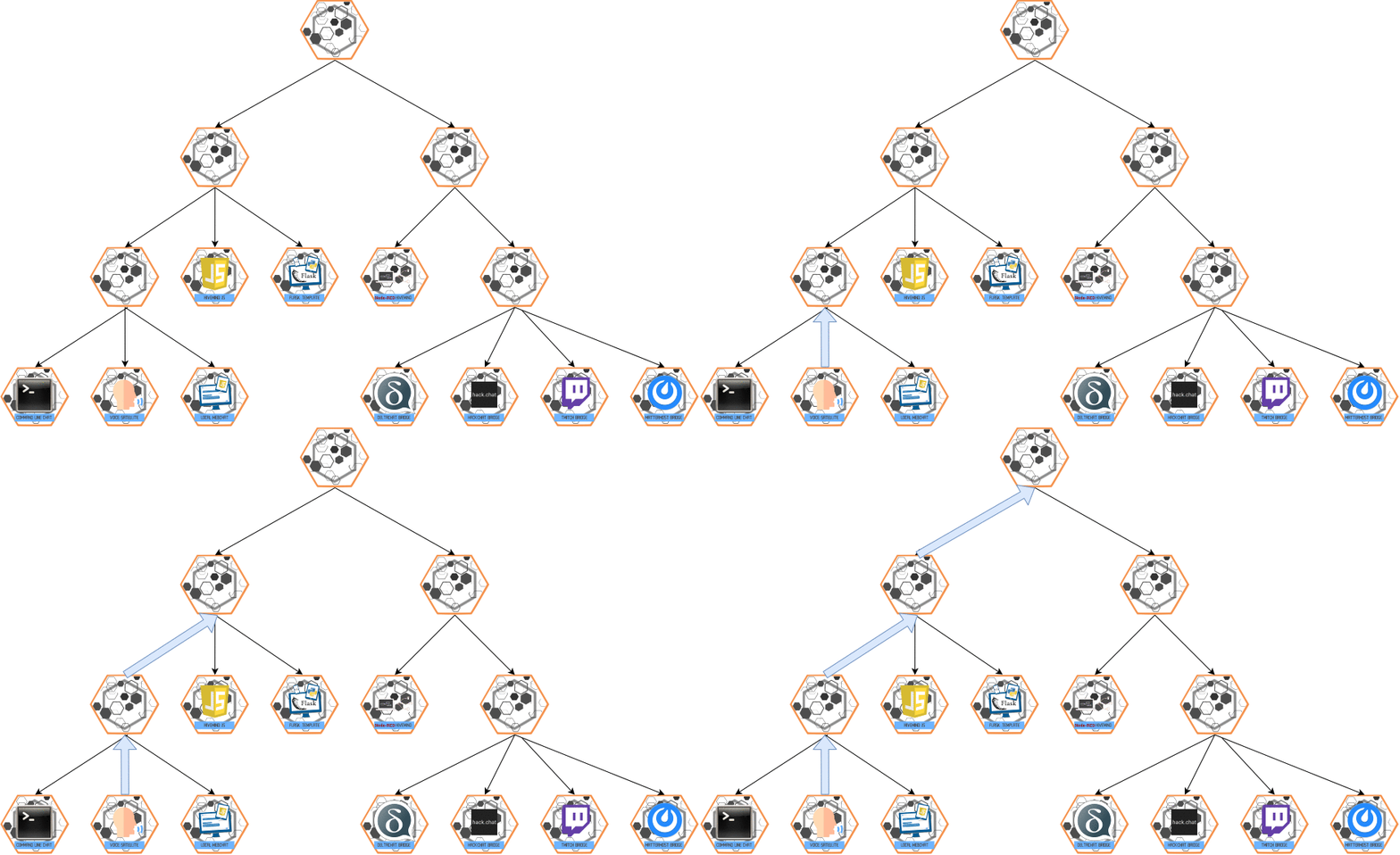
BROADCAST — downward routing
BROADCAST travels from a hivemind-core instance down to all connected satellites. Supports a target_site_id field to reach only satellites in a specific location — for example, announcing dinner is ready in the kitchen.
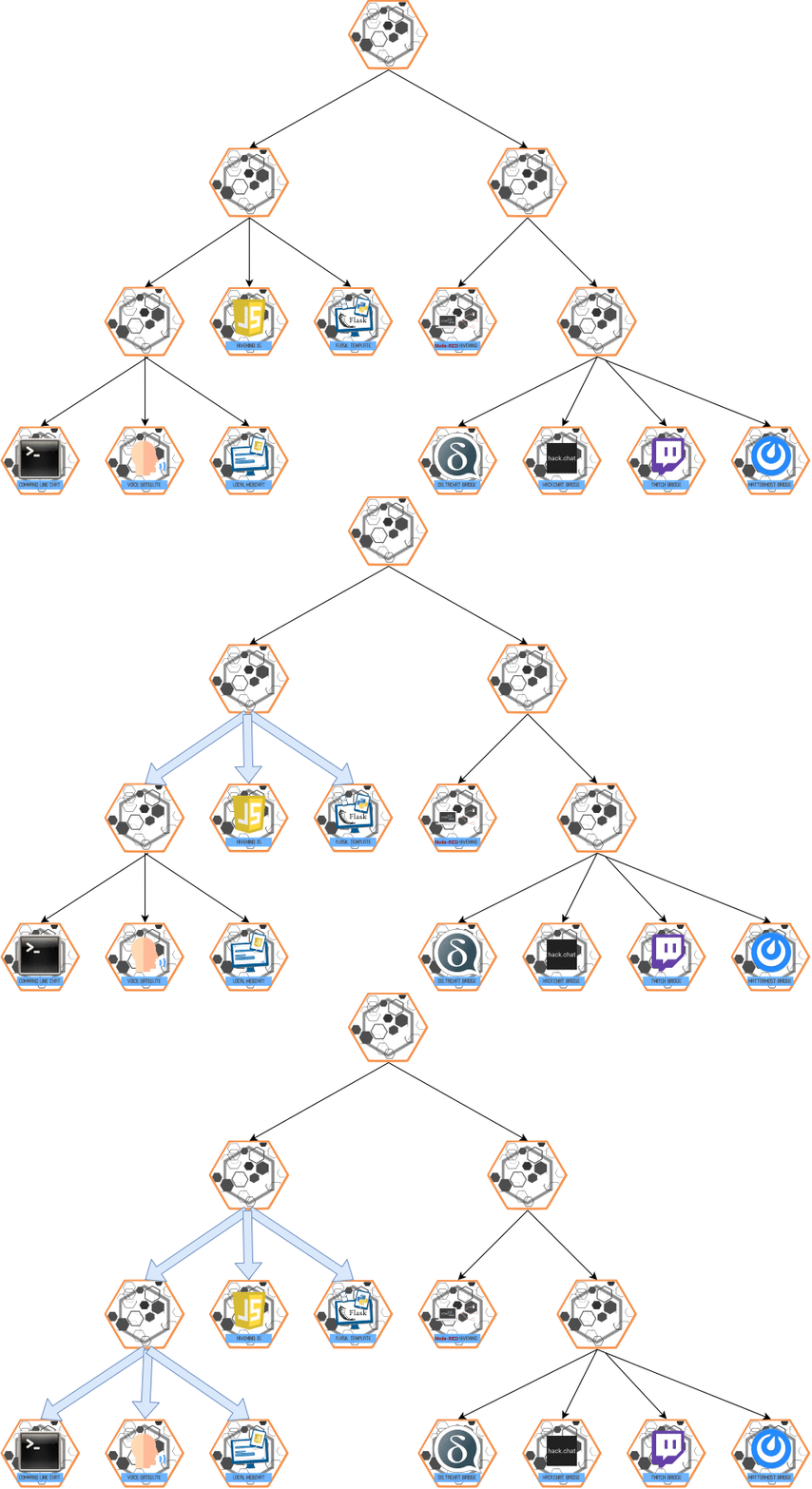
PROPAGATE — all-directions flood
PROPAGATE delivers a message to all connected nodes, both up and down the tree simultaneously. Useful for mesh-wide announcements and topology discovery (PING is always wrapped in PROPAGATE).

A flood in a mesh with a cycle would circle forever, so every forwarding node leaves a mark. Before it forwards a PROPAGATE, ESCALATE, CASCADE, or PING, the node appends a hop naming itself to the message route, keyed on the node's public key. If a message arrives whose route already names the node, the node does not forward it again and the flood dies there.
This stops the forwarding only. A node named in the route still handles the message locally, so callbacks, local bus delivery, and PING mapping all still run. It withholds the onward fan-out and the upstream forward.
QUERY — routed request with response
QUERY travels upward like ESCALATE, but expects a response back. Each node in the chain attempts to answer from its local agent; the first node that can answer returns a response routed back downstream to the originator. If no node can answer, the root returns a hive.query.timeout error response.
CASCADE — scatter/gather
CASCADE floods in all directions like PROPAGATE, and every node that can answer sends a response back. The originator collects responses via CascadeAggregator and applies a select callback to pick the best answer. See Protocol — CASCADE.
Note:
RENDEZVOUScarries store-and-forward mail between nodes that are never online together. Core routes it to a mailbox when the optional hivemind-rendezvous package is installed and enabled; every other node answersnot_a_rendezvous_node. See Message types — RENDEZVOUS.
Forwarding between tiers
A child in the tree usually answers for itself. But sometimes you want a middle node that doesn't — one that just passes traffic through in both directions, like a repeater extending the hive one hop further. There is nothing extra to install for that: it is the same hivemind-core with an upstream, wired to a parent above and satellites below.
You give a hivemind-core an upstream by calling
HiveMindListenerProtocol.bind_upstream(slave_protocol) after the slave is bound to a
bus. From then on it fans traffic both ways:
BROADCASTandPROPAGATEfrom the upstream master are fanned out to all downstream clients.QUERYandCASCADEfrom the upstream master are also fanned out downstream.- Downstream
PROPAGATE,ESCALATE,QUERY, andCASCADEare forwarded upstream.
This is transparent to both the satellites below and the master above. The chain can be arbitrarily deep:
A QUERY sent by Satellite A travels up through the middle node. If that node's local agent answers, the response returns directly. If not, the QUERY continues to the root. The response retraces the path back to Satellite A.
A CASCADE sent by Satellite A is forwarded to both Satellite B and up to the root (and its satellites). Responses flow back from all of them.
Permissions across nested hives
Stacking servers raises a fair worry: if a guest connects to a child hive, could it reach past that child and command the root? No — and the reason is worth internalising. Each hop enforces its own permission chain. A child can hand its clients no more than the root handed the child. So capability shrinks as you go down, never grows: a guest instance inherits nothing just by plugging in.
Advanced: why the boundary actually holds
The boundary is not just a convention — it is enforced at every hop. A message arriving at a hivemind-core instance is checked against that instance's allowed_types ACL by MessageTypeACLPolicy (HiveMind-core/hivemind_core/policy.py) before it is forwarded onward. So when a child instance forwards a satellite's message upstream, it is itself a client of the root and is re-checked against the permissions the root granted it. A capability the root never granted the child instance can never be smuggled through by a downstream device.
For concrete multi-hop routing tables and worked topology examples, see the hivemind-test-harness docs (07-message-routing.md and 03-topologies.md in particular).
Use cases
That's a lot of machinery; here's what it's for. Three shapes people actually build, each leaning on a different piece of what you just read.
Multi-room home: One root hivemind-core runs OVOS. Each room has a child instance that controls local devices. Satellites in each room connect to the child instance. Skills running on the root can BROADCAST to specific rooms.
Shared household: Two housemates each run their own OVOS instance (John and Jane). Both connect to a shared root hivemind-core (George) that controls shared smart-home devices. John and Jane route shared-home commands through George, but keep personal data (calendars, playlists) local to their own instances.
Guest access: A guest instance is created temporarily under the root. Guest satellites connect to it. The root grants the guest instance limited permissions; when the guest leaves, the entry is removed.
[George / Root hivemind-core]
    ├──→ [John's instance] ──→ phone, personal skills
    ├──→ [Jane's instance] ──→ phone, personal skills
    └──→ [Guest instance]  ──→ voice satellites in living room
Local hives (no network)
One last shape, and it barely looks like a network at all. A "local hive" is a hivemind-core instance and a satellite running on the same machine — no real hop between them. Why bother? Because it lets two processes on one host talk over the HiveMind protocol as if they were across the room: a skill can run as a satellite and hand certain intents off to a second OVOS instance next door, all without a wire.
Next: Protocol for the message types in detail, or Security for how permission chains compose across hops.
Source
Validated against the HiveMind source:
hivemind_core/protocol.py—bind_upstream, upstream and downstream fan-out, and ESCALATE/BROADCAST/PROPAGATE/QUERY/CASCADE routinghivemind_core/policy.py— per-hopallowed_typesre-check that enforces the permission boundary- hivemind-test-harness
docs/— multi-hop routing tables and topology examples