Plugin Architecture
hivemind-core is less a monolith than a socket board. Almost nothing about it is welded in place: the way it talks to devices, which AI actually answers a question, how it deals with raw audio, where it files the guest list, and how it decides what each device may do — every one of those is a part you can pull out and replace. Want the LLM brain instead of the skills brain? Swap one part; the satellites never notice. Want to store credentials in Redis instead of a file? Swap another. Five families of parts, one board they all plug into, and a manager that snaps the right ones in at startup.
In a nutshell
- Five families of swappable parts: network protocol (how bytes arrive), agent protocol (who answers), binary data handler (raw audio), database (the guest list), and policy (who may do what).
- Out of the box you get the WebSocket + HTTP transports, the OVOS brain, a SQLite guest list, and the OVOS permission policy. No audio handler loads until you ask for one.
- You wire the parts together in
~/.config/hivemind-core/server.json. Heads-up: the name youpip installisn't always the name you write in config — the package and the plugin can differ.
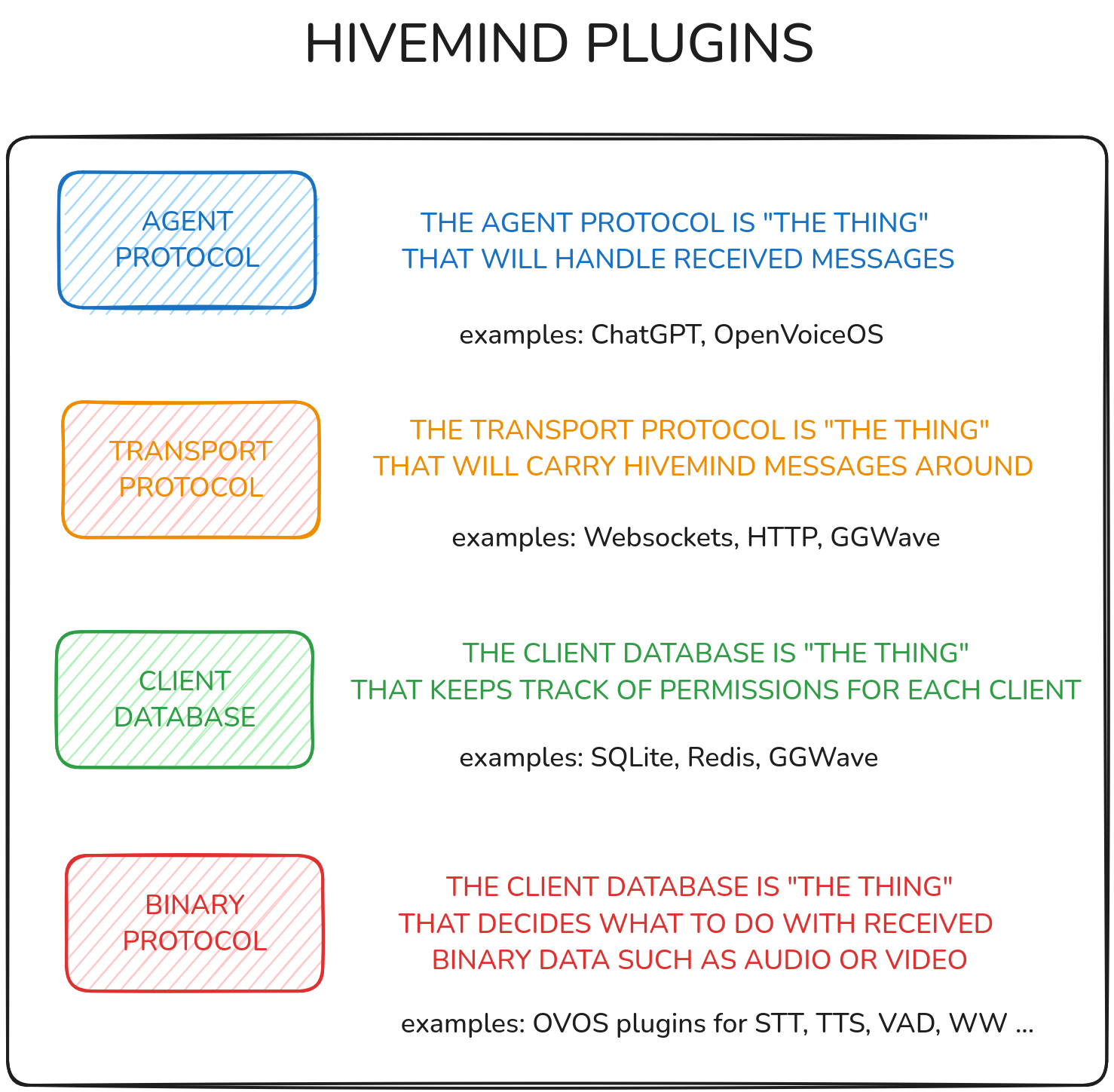
Plugin categories
Five families, five jobs. The tables below list what's available in each — but as you read them, the useful question isn't "what are all these?" so much as "which one would I swap to change this?" Each family answers exactly one such question.
Network protocol plugins
The question they answer: how do bytes get in and out? These control how HiveMind listens for and connects to satellites.
| Plugin | Transport | Default port | Status |
|---|---|---|---|
hivemind-websocket-plugin |
WebSocket (ws:// / wss://) | 5678 | stable, default |
hivemind-http-plugin |
HTTP (polling) | 5679 | stable, default |
hivemind-mqtt-plugin |
MQTT (broker) | 1883 | alpha (PyPI hivemind-mqtt-protocol) |
hivemind-usenet-wormhole |
Usenet store-and-forward | — | experimental, unpublished |
WebSocket and HTTP are enabled by default in server.json. The MQTT plugin
(package hivemind-mqtt-protocol) is published as an alpha and ships the server-side
transport only; a satellite-side MQTT client is planned. The Usenet wormhole
(package hivemind-usenet) is an experimental covert/fallback transport — not a
real-time channel, not on PyPI (it pulls git-only carrier libraries).
Agent protocol plugins
The question they answer: who actually thinks? This is the one swap that changes what your assistant is — skills, an LLM, or someone else's agent — while the satellites never notice.
| Plugin | Back-end |
|---|---|
hivemind-ovos-agent-plugin |
OpenVoiceOS (default) |
hivemind-persona-agent-plugin |
ovos-persona / LLM solvers |
hivemind-a2a-agent-plugin |
Google A2A agents (bridges the hive to A2A) |
Binary data handler plugins
The question they answer: what happens to raw audio? This is the ear on the server — the piece a thin satellite leans on to have its speech transcribed.
| Plugin | Function |
|---|---|
hivemind-audio-binary-protocol-plugin |
Server-side wakeword, STT, VAD, TTS for mic-satellite and voice-relay |
No binary plugin is loaded by default. Install and configure one when you need server-side audio processing.
Database plugins
The question they answer: where does the guest list live? A file for one server, Redis when several share it.
| Plugin | Backend |
|---|---|
hivemind-sqlite-db-plugin |
SQLite (default for new installs) |
hivemind-json-db-plugin |
JSON file |
hivemind-redis-db-plugin |
Redis (from the hivemind-redis-database package) |
Policy plugins
The question they answer: who's allowed to do what? Admission control — the gate every
message passes before it reaches the agent. Policy plugins are loaded as an ordered chain (group hivemind.policy) and are consulted for every inbound message; they configure only via the policy.chain JSON block (there is no separate module selector like the other families).
| Plugin | Function |
|---|---|
hivemind-ovos-agent-policy |
Per-client skill/intent blacklists for the OVOS agent (default) |
The built-in allowed_types ACL (MessageTypeACLPolicy) is always force-prepended to the chain and cannot be removed. See Security — How the policy chain works and Writing Plugins — Policy plugins.
Configuration
All five families meet in one place: server.json. Reading the default file is the
fastest way to see how the parts name each other — every module key is one part snapping
into its socket:
{
  "agent_protocol": {
    "module": "hivemind-ovos-agent-plugin",
    "hivemind-ovos-agent-plugin": {
      "host": "127.0.0.1",
      "port": 8181
    }
  },
  "binary_protocol": {
    "module": null
  },
  "network_protocol": {
    "hivemind-websocket-plugin": {
      "host": "0.0.0.0",
      "port": 5678
    },
    "hivemind-http-plugin": {
      "host": "0.0.0.0",
      "port": 5679
    }
  },
  "policy": {
    "chain": [
      {"module": "hivemind-ovos-agent-policy"}
    ]
  },
  "database": {
    "module": "hivemind-sqlite-db-plugin",
    "hivemind-sqlite-db-plugin": {
      "name": "clients",
      "subfolder": "hivemind-core"
    }
  }
}
Installing plugins
Plugins are installed as Python packages via pip:
After installation, update server.json to reference the new plugin (entry-point) name — note that the installed package name may differ from the plugin name used in config (e.g. the hivemind-redis-database package provides the hivemind-redis-db-plugin plugin, and hivemind-audio-binary-protocol provides hivemind-audio-binary-protocol-plugin).
Developing plugins
Use the hivemind-plugin-manager package to discover and instantiate plugins programmatically:
from hivemind_plugin_manager import find_plugins, HiveMindPluginTypes

# Discover all installed database plugins
print(find_plugins(HiveMindPluginTypes.DATABASE))

# Discover all installed agent protocol plugins
print(find_plugins(HiveMindPluginTypes.AGENT_PROTOCOL))
Factory classes handle instantiation:
from hivemind_plugin_manager import DatabaseFactory, AgentProtocolFactory

db = DatabaseFactory.create("hivemind-redis-db-plugin",
                            password="secret", host="localhost", port=6379)

agent = AgentProtocolFactory.create("hivemind-ovos-agent-plugin")
To author your own plugin, see Writing Plugins.
Source
Validated against the HiveMind source:
hivemind_plugin_manager/__init__.py—HiveMindPluginTypes(the five families: database, network, agent, binary, policy)hivemind_core/config.py— defaultserver.jsonwiring, including thepolicy.chainblock