Pairing Devices
You can register clients in a Mind through the command line or with audio.
Command line pairing
First, register the satellite device on the HiveMind server:
hivemind-core add-client
Credentials added to database!

Node ID: 2
Friendly Name: HiveMind-Node-2
Access Key: 5a9e580a2773a262cbb23fe9759881ff
Password: 9b247ca66c7cd2b6388ad49ca504279d
Encryption Key: 4185240103de0770
WARNING: Encryption Key is deprecated, only use if your client does not support password
Then set the identity file on the satellite device:
hivemind-client set-identity --key 5a9e580a2773a262cbb23fe9759881ff --password 9b247ca66c7cd2b6388ad49ca504279d --host 0.0.0.0 --port 5678 --siteid test
identity saved: /home/miro/.config/hivemind/_identity.json
Check the created identity file if you like:
cat ~/.config/hivemind/_identity.json
{
    "password": "9b247ca66c7cd2b6388ad49ca504279d",
    "access_key": "5a9e580a2773a262cbb23fe9759881ff",
    "site_id": "test",
    "default_port": 5678,
    "default_master": "ws://0.0.0.0"
}
Test that a connection is possible with the identity file:
hivemind-client test-identity
(...)
2024-05-20 21:22:28.003 - OVOS - hivemind_bus_client.client:__init__:112 - INFO - Session ID: 34d75c93-4e65-4ea9-b5f4-87169dcfda01
(...)
== Identity successfully connected to HiveMind!
If the identity test passes, your satellite is paired with the hive.
Audio pairing with GGWave
This feature is a proof of concept and a work in progress.
GGWave sends data over sound for HiveMind.
hivemind-core and hivemind-voice-sat support hivemind-ggwave.
Prerequisites:
- a device with a browser, such as a phone.
- a hivemind-core device with a microphone and speaker, such as a Mark 2.
- an unpaired voice satellite device with a microphone and speaker, such as a Raspberry Pi.
- all devices in audible range of each other, so each can hear the sounds the others emit.
Workflow:
- Launch hivemind-core and note the provided code, for example
HMPSWD:ce357a6b59f6b1f9. - Copy the code and emit it with GGWave (see below).
- The voice satellite decodes the password, generates an access key, and sends it back with GGWave.
- The master adds a client with the key and password, and sends an acknowledgment (containing the host) with GGWave.
- The satellite gets the acknowledgment, then connects to the received host.
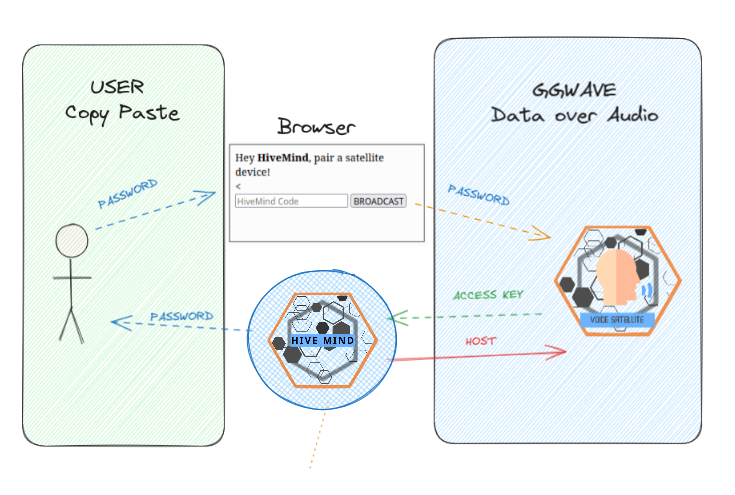
- Exchange the string manually through a browser.
- Or use a talking button.
The Identity File
A node has one identity: one PGP keypair, one Noise static key, and one set of pinned peer keys, used in both directions — serving its own clients and dialing its master. The identity file stores that identity plus the settings a node needs to connect and communicate within the HiveMind network.
Credentials (access key, password), the useragent and site_id are not part of that identity. They say how to reach one particular master, so a node that both serves clients and connects upstream holds its own credentials as well as its master's. A client reads credentials from the identity file only as a fallback, when none were passed explicitly, and never writes them back to it — connecting to a master never overwrites the node's own name or credentials.
If a node has no keypair yet, one is generated and persisted automatically the first time it is needed. An unwritable config directory does not stop the node from starting; it just cannot generate or keep a keypair, so it answers PING anonymously and cannot be mapped (see node identity below).
Connection parameters can be set at launch time, but this file lets you reuse them across the whole OS.
Contents of the identity file
A node is one application acting as a peer, not the user or the host that runs it. Each application holds its own identity. Two applications run by the same user on the same host are two separate nodes, and each application's identity file lives in a location keyed on that application's own name, not in one path shared by every application the user runs.
The shipped client does not yet follow that rule: today, a client that does
not set its own storage location writes the identity file to the same
~/.config/hivemind/_identity.json path for every application. CRYPTO-1 §2
requires a per-application location instead; the client has not caught up.
The identity file contains:
| Field | Description |
|---|---|
name |
A human-readable label for the node, not guaranteed to be unique. |
password |
The password used to generate a session AES key for secure communication within the HiveMind network. |
access_key |
A unique access key assigned to the node for identification and authentication. |
site_id |
An identifier for the physical location or context where the node operates. |
default_port |
The default port number used to connect to the HiveMind core. |
default_master |
The default host (address) of the HiveMind core the node connects to. |
public_key |
The ASCII-encoded public PGP key used to authenticate the node within the HiveMind network. |
secret_key |
The path to the private PGP key file, which uniquely identifies the node and proves its identity. |
noise_key |
The path to the static X25519 private key used by the protocol-v3 Noise handshake. Generated and persisted on first use so key pinning survives a restart. |
pinned_noise_keys |
Trust-on-first-use store of peer node id → Noise static public key. A later handshake whose key contradicts the pin is a fatal authentication failure. |
trusted_keys |
Alias → public key mapping of peers this node trusts for INTERCOM, PROPAGATE and CASCADE origin verification. |
By keeping these details in the identity file, nodes can join the HiveMind network securely and efficiently.
If a node needs to communicate securely with, or authenticate, another node that is not the master, it can use the public key. See intercom messages for details.
You can also target groups of devices by their site_id. For example, you can propagate a speak message to announce dinner is ready, or broadcast a bus message that orders all devices with a camera in an area to take a picture.
Public key
The public key in the identity file is part of a PGP key pair that uniquely identifies the node. It serves several purposes:
- Unique node identification: the PGP key uniquely identifies this node within the HiveMind network.
- Inter-node authentication: nodes use the PGP key to authenticate each other, so only authorized nodes can communicate within the network.
- Network independence: the PGP key lets nodes identify each other regardless of the specific HiveMind core (mind) they connect to. Even if a node switches minds, it still recognizes and authenticates other nodes by their PGP keys.
- Addressing and mapping: the public key is the node's address for
INTERCOMmessages, its entry on a hive map, and its hop for loop suppression when a message is relayed across the mesh. A node with no public key answersPINGanonymously and cannot be mapped.
Private key
The private key is the only way for a node to read a message encrypted with its matching public key. Keep this file safe and private at all times.
By default, HiveMind stores the private key at ~/.config/hivemind/HiveMindComs.asc.
If you believe your private key was compromised, or you simply want new keys, use the hivemind-client reset-pgp command.